

Month: November 2025
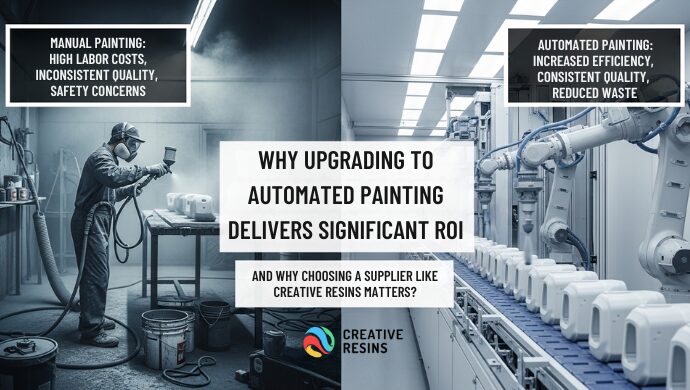
Why Upgrading from Manual Painting to an Automated Painting Line Delivers Significant ROI And Why Choosing a Supplier Like Creative Resins Matters
In today’s competitive manufacturing landscape, consistency, efficiency, and sustainability are no longer optional, they’re essential. Whether you operate in the glass, plastics, metal, or composite industry, the finishing process plays a critical role in product quality and brand reputation.
For many businesses, manual painting has long been the norm. However, as demand increases and quality expectations tighten, more companies are discovering the significant advantages of upgrading to an automated painting line.
At Creative Resins, we understand these challenges firsthand. With decades of experience supplying both manual spray systems and fully automated painting lines, alongside our own specially formulated coating systems, we’re uniquely positioned to support customers from initial proof-of-concept through long-term operational efficiency.
Here’s why automation is transforming finishing departments, and why partnering with a supplier who provides both the equipment and the coatings ensures the highest possible ROI.
The Limitations of Traditional Manual Painting
Manual painting has its place, particularly for:
- Bespoke jobs
- Small-batch production
- Prototyping
- Colour matching
However, it also introduces challenges such as:
- Inconsistent finish quality
- Variable paint consumption and overspray
- Higher labour costs and reliance on skilled operators
- Slower production throughput
- Increased rework or rejects due to human error
- Limited traceability and process control
As production demands scale, these limitations compound, reducing efficiency and cutting into profit margins.
The Key Benefits of Automated Painting Lines
Automated painting systems deliver performance improvements that manual methods cannot match.
1. Unmatched Consistency and Quality
Automation ensures identical application every cycle, correct thickness, uniform coverage, and fewer defects. This improves finish quality and customer satisfaction.
2. Significant Reduction in Paint Usage
Precision spraying and high-transfer-efficiency equipment reduce overspray and wasted material. Many customers experience 15–40% paint savings.
3. Faster Production and Higher Throughput
Automated systems operate continuously at controlled speeds, enabling predictable, high-volume output and allowing you to take on larger orders.
4. Lower Labour Costs
Automation reduces dependence on highly skilled sprayers, minimises manual handling, and allows staff to be redeployed to more value-added tasks.
5. Improved Health, Safety & Environmental Performance
Robotic or enclosed spray environments reduce operator exposure to chemicals and VOCs, while lowering emissions and simplifying compliance.
6. Data, Traceability & Process Control
Automated lines integrate with smart systems that record:
- Paint consumption
- Cycle times
- Batch data
- Maintenance logs
This provides real-time troubleshooting and supports continuous improvement.
ROI: How Quickly Does an Automated Line Pay for Itself?
Return on investment varies by:
- Production volume
- Number of shifts
- Type of coating
- Automation level
Typical ROI is achieved through:
- Reduced labour cost
- Lower material consumption
- Fewer rejects and less rework
- Increased throughput
- Improved reliability and maintenance efficiency
Most customers see ROI within 12–36 months, with high-volume facilities achieving this even sooner.
Why Creative Resins Offers a Unique Advantage
Creative Resins uniquely supplies the complete finishing solution:
- Manual spray equipment
- Automated painting lines
- Specialist coatings designed to run perfectly on both
This provides four major advantages:
1. Perfect Compatibility
When coatings and equipment come from the same supplier, issues such as poor atomisation, adhesion failures, incorrect viscosity, and unnecessary downtime are avoided.
2. One Supplier, One Support Team
From installation and training to maintenance and chemical supply, a single partner manages the entire process, ensuring consistency and fast support.
3. Scalable Solutions
Creative Resins offers both manual and automated systems, enabling businesses to:
- Start with manual spraying and upgrade later
- Operate hybrid manual/automated lines
- Use manual spraying for bespoke work and automation for volume
This ensures investments match real production needs.
4. Ongoing R&D and Innovation
Our in-house laboratory continuously develops new coatings, colours, and system enhancements so your finishing line evolves with your business.
The Best of Both Worlds: Manual + Automated
Many companies benefit from combining both methods.
Manual Spray Ideal For:
- Quick colour matching
- Bespoke or small-batch work
- Touch-ups and prototyping
Automated Lines Ideal For:
- Consistent, large-scale production
- High-efficiency application
- Precise control and repeatability
Creative Resins is one of the few suppliers able to design a fully integrated system where both processes work together seamlessly.
Final Thoughts: Future-Proofing Your Finishing Process
Upgrading from manual to automated painting is not just a technical improvement, it’s a strategic investment. With measurable benefits including:
- Higher quality
- Reduced costs
- Faster production
- Strong ROI
automation strengthens your competitive advantage.
By choosing Creative Resins as your partner, you gain:
- Greater reliability
- Simplified support
- Optimised performance
- Long-term value
Whether you’re ready for full automation or prefer a gradual scale-up, Creative Resins is committed to helping you build a finishing process that delivers quality, consistency, and profitability for years to come.
Revolutionary Resin Techniques: Creating Commercial-Grade-Stained Glass in Half the Time
Most glass fabricators don’t think twice about how they create decorative glass. They stick with traditional lead came methods because “that’s how it’s always been done.” But if you’re losing bids to faster competitors, turning away commercial projects with tight deadlines, or struggling to find skilled craftspeople, it might be time to look at one gamechanging alternative: professional resin-based stained-glass systems.
What if your decorative glass production could match traditional quality while cutting production time in half? Let’s explore why commercial-grade resin techniques could transform your glass fabrication business.
⚡ What Are Professional Resin-Stained Glass Systems, and Why Should You Care?
Professional resin-stained glass systems use specialized outline and infill resins to replicate traditional lead glass aesthetics with modern efficiency. It’s like having a traditional craftsperson skill set in a bottle, creating authentic stained-glass effects without years of specialized training.
In fact, the stained-glass market has grown to $4.31 billion in 2024, with projections reaching $6.74 billion by 2033. This growth isn’t just about nostalgia. Modern architects and designers are specifying decorative glass again, but they need it faster and more affordably than traditional methods allow.
But this is crucial; it only delivers professional results when you use the right materials and techniques. A craft-grade resin kit won’t produce the durability and optical quality that commercial projects demand.
⚡ Why Professional Techniques Make All the Difference
Think of resin-stained glass like automated paint spraying versus hand-brushing. Both can work, but one scales to commercial production while maintaining consistent quality.
Professional resin techniques deliver:
- Substrate versatility bonding to glass, wood, acrylic, aluminum, ceramic, and stainless steel
- Weather resistance with 10-year exterior warranties even in extreme climates
- Production speed completing panels in hours instead of days
- Labor flexibilityusing technicians instead of specialized craftspeople
If you’ve ever had to turn down a profitable project because your traditional production couldn’t meet the timeline, professional resin systems solve that problem.
⚡ The Technology: Two-Component Chemistry for Permanent Bonds
Here’s where things get interesting.
Professional resin systems use two-component chemistry that creates permanent molecular bonds during curing. The outline resin, typically mixed at 1:1 ratio, cures through chemical reaction to form raised lines on the glass surface. These lines contain the infill resins, concentrated transparent pigments that bond permanently to the substrate.
This advanced formulation:
- Creates UV-stable bonds that won’t yellow or degrade over decades
- Ensures complete curing without requiring heat or specialized equipment
- Delivers consistent performance across varying temperatures and humidity levels
But many craft-grade products use inferior formulations that can’t match this durability.
The difference shows color stability, adhesion strength, and weather resistance.
Professional systems maintain their properties under temperature cycling from -40°C to +80°C, salt spray exposure, and 2,000+ hours of accelerated UV testing, conditions that cause basic products to fail Creative Resins Distribution.
⚡ What the Market Data Says About Production Efficiency
Traditional stained-glass production involves 60-70% labor costs versus 30-40% materials Straits Research. That labor-heavy model works fine for custom art pieces, but it struggles with commercial volume.
Professional resin systems shift this equation:
- Reduced specialized labor using technicians instead of master craftspeople
- Faster production cycles completing standard panels in 3-4 hours versus full-day traditional timelines
- Lower breakage losses eliminating fragile cutting and grinding steps
- Simplified installation with lighter weight and more durable finished panels
And if you’re competing for hotel lobbies, restaurant partitions, or residential development projects, production speed directly impacts your ability to win bids.
⚡ Commercial Applications Where Resin Systems Excel
Professional resin techniques aren’t just for hobbyists; they’re solving real production challenges:
Hospitality Projects: Hotels need custom lobby features and dining area partitions on tight construction schedules. Resin systems deliver brand-specific designs without the lead times traditional methods require.
Commercial Interiors: Office buildings want privacy glass for conference rooms and executive areas. Decorative resin patterns provide visual screening while maintaining the open feel of modern workplaces’ demand.
Residential Development: Builders differentiate their properties with custom entry features and interior upgrades. Resin systems make decorative glass accessible at production-home price points.
Religious Facilities: New construction churches and temples balance aesthetic goals with budget constraints. Resin techniques enable decorative glass in secondary spaces while reserving traditional craft for primary sanctuaries.
Unlike basic craft applications, these commercial projects require documented performance, warranty support, and production consistency, exactly what professionalgrade resin systems deliver.
⚡ How Automated Equipment Transforms Production Capacity
Here’s something most fabricators don’t realize semi-automated dispensing equipment eliminates the skill bottleneck entirely, and at investment levels far below traditional shop setup costs.
Professional dispensing systems:
- Import digital designs reproducing patterns with perfect consistency
- Control bead width automatically adjusting for different viewing distances
- Enable multi-plot capabilities handling complex designs without operator judgment
- Include costing features calculating material usage for accurate project bidding
Computer-controlled dispensing equipment starts around £8,000-£15,000, representing 40-60% lower investment than complete traditional studios requiring grinders, soldering stations, pattern equipment, and extensive glass inventory.
Of course, manual bottle applications work perfectly for small custom projects. But commercial fabricators handling multiple identical units gain massive productivity advantages through automation.
⚡ Advanced Color Control: Creating Custom Effects
Professional resin systems offer color flexibility that exceeds traditional glass options:
13+ base pigments that intermix for thousands of custom hues
Opacity control from fully transparent to solid opaque through white pigment addition
Texture effects using stipple additives and crazy base techniques
Metallic finishes with copper, silver, and gold tones for Victorian aesthetics
Batch consistency through documented mixing ratios for multi-panel projects
Your decorative glass should match design specifications precisely, not compromise based on available glass colors from European suppliers with long lead times.
⭐ Quality Control: What Separates Professional from Craft-Grade
Professional-grade resin systems enable applications impossible with basic products:
Exterior Installations: Meeting 10-year warranty requirements through validated UV resistance, salt spray testing, and thermal cycling protocols. These aren’t marketing claims; they’re documenting performance standards.
Architectural Specifications: Providing the technical data sheets, MSDS documentation, and performance certificates that architects and general contractors require for commercial projects.
Production Consistency: Delivering identical results across dozens of panels produced over weeks or months, critical for large hospitality or office projects where visible variations would be unacceptable.
Multi-Substrate Applications: Bonding reliably to glass, wood, aluminum, and ceramic, expanding design possibilities beyond what traditional lead glass can achieve.
Production Economics: The Real Cost Comparison
Basic material costs tell only part of the story. Professional resin systems may cost 20-30% more per square meter than lead and glass supplies, but total project economics favor resin through multiple factors:
Labor Efficiency: Reducing skilled craftsperson hours by 60-75% on standard patterns, the biggest cost driver in traditional production.
Equipment Investment: Requiring 40-60% less capital than traditional shop setup, freeing cash for marketing and business development.
Market Expansion: Enabling profitable bidding on commercial projects that traditional timelines couldn’t support, growing addressable market opportunities.
Installation Simplification: Cutting site labor costs through lighter weight panels and simplified mounting procedures.
The business case isn’t about material costs; it’s about total production economics and market positioning.
⭐ Final Thoughts: Transform Your Production Capabilities
Your glass fabrication business deserves better than choosing between slow traditional methods and substandard craft products. Choosing professional-grade resin systems isn’t abandoning quality speed; it’s adopted modern techniques that deliver authentic aesthetics with commercial efficiency.
So, the next time you evaluate a decorative glass opportunity, skip the assumption that traditional methods are your only option for quality results. Instead, consider proven resin systems with documented performance, comprehensive technical support, and production capabilities that match modern project demands. Your bottom line will notice the difference.
⭐ Ready to transform your decorative glass production?
Creative Resins’ professional stained glass resin systems are engineered specifically for commercial glass fabricators and architectural processors. Our Supreme Outline Resin and Infill Resin range delivers the weather resistance, optical clarity, and production consistency that demanding projects require, backed by comprehensive technical support and application training.
[ Contact Creative Resins for Professional Resin-Stained Glass Solutions →]
Visit creative-resins.co.uk or email sales@creative-resins.co.uk to discuss your production requirements and request sample materials.